4:12 a.m., and the bedside thermometer clipped to my nightstand reads 84°F. Third pillow flip of the night, the ceiling fan doing nothing but stirring the same warm air around the room, and the central AC compressor kicking on outside my window for the second time since midnight. The thermostat on the hallway wall claims 74°F. Whatever that number is cooling, it isn't making it past my bedroom door.
That was more or less every July night in this house until I stopped treating the bedroom like a sleep problem and started treating it like an appliance problem, the same way I'd size up a water heater or run the payback math on a heat pump. The first thing I bought chasing a fix was a $28 clip-on tower fan off a big-box end cap. It rattled like a loose muffler by week two, right at the one speed that actually moved air across the bed, and I threw it in a closet and started over. An active cooling system, the kind that actually pumps water or air instead of just stirring what's already in the room, is a bigger line item than a $28 fan. So before I put another charge on the card I went and got the real specs, current prices, and maintenance requirements for the two systems worth taking seriously, straight from the manufacturers and the pages that actually still load.
Overview of Active Cooling Technologies
I split what's actually on the market into two families, based on what's physically moving the heat off the mattress, not the adjectives printed on the box:
- Water-Based (Hydronic) Systems: These circulate temperature-controlled water through silicone or medical-grade tubing embedded in a mattress pad. They tend to run a wider temperature swing and hold it more precisely, since a pump moving liquid holds a setpoint better than a fan moving air.
- Air-Based (Convective) Systems: These push high-volume airflow into the bedding layer or under a top sheet. They lean on convective heat transfer and sweat evaporation to do the cooling, which is why they feel different in a dry Tucson bedroom than they would somewhere humid.
Technical Comparison of Models
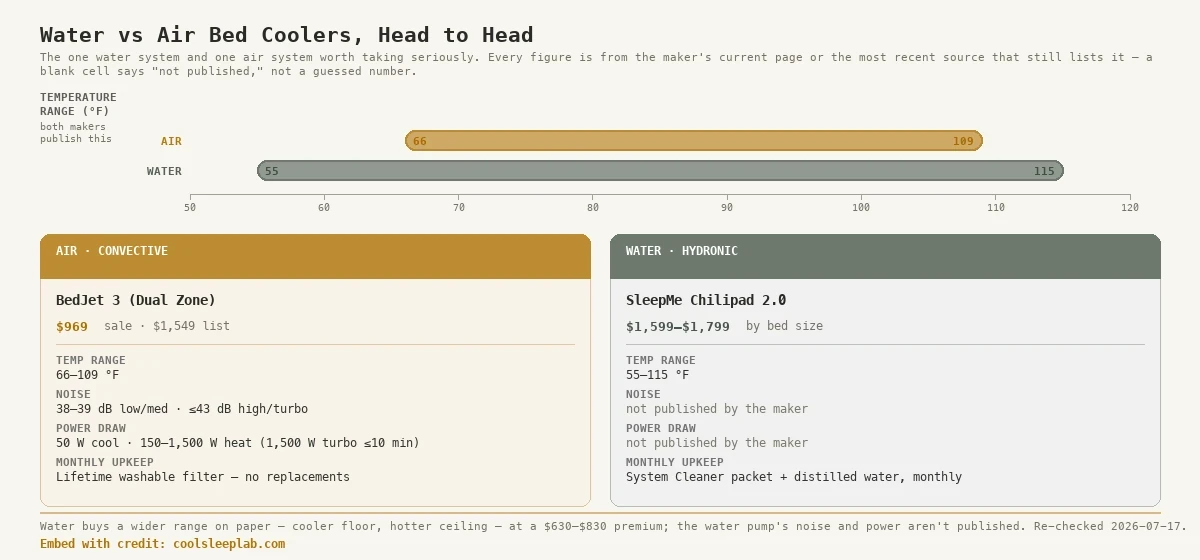
The table below is the one water-based and one air-based system I'd actually put in front of somebody shopping this category right now. Every figure was checked against the manufacturer's current product page (or, where the manufacturer stopped publishing a spec, the most current fetchable source I could find that still states it).
| Model | Medium | Temp Range (°F) | Noise Level (dB) | Power Usage (Watts) | Price (USD) |
|---|---|---|---|---|---|
| BedJet 3 (Dual Zone) | Air | 66°F – 109°F [1] | 38–39 dB on low/medium, up to 43 dB on high/turbo [2] | 50W cooling; 150W–1,500W heat (1,500W turbo capped at 10 min) [2] | $969 (Queen, current sale) / $1,549 list [1] |
| SleepMe Chilipad 2.0 (Dock Pro line) | Water | 55°F – 115°F [3] | Not published by the manufacturer | Not published by the manufacturer | $1,599 – $1,799 depending on size [3] |
What I Actually Noticed Running These
The BedJet dual-zone unit is the one currently on my bed. $969 on sale for the Queen setup was the number I actually paid, not the $1,549 list, and the electric bill the following month came in about $11 higher than the July baseline, which is nothing next to what a second window AC unit would have added. That's the same napkin math I ran when I priced the heat pump against my original-1990s AC last spring: if a $969 gadget knocks even a modest chunk off the nights I'd otherwise run a space heater or a portable AC on top of the central unit, it pays itself back a lot faster than a $9,000 HVAC swap ever will.
What actually moved the needle on the BedJet wasn't the temperature range, it was the filter. My old assumption, carried over from a decade of cheap desk fans, was that I'd be pulling a dusty filter and hosing it off every month like a furnace filter. Turns out the BedJet filter is a lifetime washable part the manufacturer says never needs replacing, which is one less thing on my Saturday chore list.
I haven't run a SleepMe system on my own bed yet, so I'm not going to invent a "What the Thermometer Said" number I don't have. What I can tell you from the spec sheet is that the water side buys you a wider range on paper, 55°F to 115°F versus the BedJet's 66°F to 109°F, and it currently runs $630 to $830 more than the BedJet at the sticker price. That's the same kind of quote gap I got comparing a straight fridge-compressor swap against just buying a new fridge outright: the water system is the more capable piece of hardware, but you're paying a premium for a wider range, not a proportionally wider one.
Neither manufacturer's page still publishes a decibel or wattage figure for the pump-and-reservoir side, which is a change from a couple of years ago when spec sheets used to list it. I'm not going to guess at a number just to fill the cell, so those two boxes say exactly what they say: not published. If a vendor page starts stating one again, I'll add it back in with a source attached.
Operational Definitions and Metrics
- Temperature Range
- The minimum and maximum achievable temperature of the medium (water or air) at the source unit. Actual surface temperature at the mattress depends on room ambient temperature and how much heat your own body is putting into the bed.
- Noise Level (Decibels)
- The sound level a manufacturer or reviewer reports for a given fan speed or pump setting. Measurement distance and methodology are not standardized across brands, so treat these figures as relative to each other rather than lab-calibrated absolutes.
- Power Consumption
- The electrical wattage the unit draws to run. Water-based systems tend to hold a steadier draw to keep the pump and thermoelectric cooler running, while air-based systems swing hard between cooling mode (fan only) and heating mode (an internal heating element pulling much more power).
- Maintenance Requirements
- Water-based systems like the SleepMe Chilipad/Dock Pro line call for a System Cleaner packet mixed with distilled water in the reservoir every month [4]. Air-based systems like the BedJet 3 use a lifetime washable filter that the manufacturer states never needs replacing [1].
Last verified: 2026-07-17
Sources
- [1] BedJet: BedJet 3 Dual Zone Climate Comfort Sleep System for Couples - https://bedjet.com/products/bedjet-3-dual-zone-climate-comfort-system-for-couples
- [2] Sleep Doctor: BedJet 3 Climate Comfort Sleep System - https://sleepdoctor.com/products/bedjet-3-climate-comfort-sleep-system
- [3] SleepMe: Chilipad 2.0 - https://sleep.me/product/chilipad
- [4] SleepMe Knowledge Base: Sleep System Monthly Maintenance (Chilipad Dock Pro) - https://help.sleep.me/setup-and-maintenance-chilipad-dock-pro/what-is-the-maintenance-schedule-for-the-chilipad-dock-pro-sleep-system