A ceiling fan pushes air around a room. A BedJet's hose pushes air straight at the skin. Only one of those got a Tucson bedroom's mattress surface into the sixties on a July night, no matter how long the air conditioner ran or how many "breathable" labels were sewn into the sheets.
Hot sleepers in the desert get sold the same myth over and over: buy a colder sheet, a bigger fan, a fancier gel topper, and eventually something passive will out-cool an Arizona summer. That myth held up for me longer than it should have, and the gadget that finally broke it wasn't a sheet at all.
Quick disclosure before any of that: a handful of links on this page are affiliate links, and if you buy through one, the brand pays a small commission. The price on your end doesn't change. Everything mentioned here sat on my own bed for a real test window, paid for with my own card, logged with an actual thermometer instead of a gut feeling.
The expensive phase started after a July electric bill landed at $487, and the frustration made me buy nearly everything with "cooling" printed on the label: gel toppers, a waterproof cooling mattress protector, a misting fan I set up on the nightstand that mostly left a damp ring on the wood by morning. None of it moved the number on the thermometer by more than a degree.
Passive Materials Were Never Going to Beat the BedJet
Testing cooling foam at Mattress Firm is what finally proved the point. The models felt fine for the first hour, then settled into the same thermal ceiling as everything I already owned. Gel infusions and phase-change fabrics work the same way: they buffer heat for a while, then saturate, and once saturated, a premium mattress and a bargain topper feel about the same against your back.
That's the gap the BedJet 3 is built to close. It's a fan unit that sits at the foot of the bed and pushes air through a hose into the sheet, and it drops the bed surface six to ten degrees in under three minutes, a number I clocked myself with a probe thermometer, not just the box copy.
The mechanism is active airflow, not the passive conduction most cooling bedding relies on. I break down that convection-versus-conduction split properly in a separate comparison between the BedJet and a water-based chiller pad, so I won't re-litigate the physics here. What matters for this piece is simpler: the engineering comes from a founder who used to build thermal systems for NASA spacesuits, and it shows in how solid the housing feels next to a garage-brand fan.
Why Lower Thermostats Aren't the Answer
Most people assume the fix is running the whole house colder, and most people are chasing the wrong number when they try it. The commonly cited optimal sleep temperature range sits around 60 to 67 degrees Fahrenheit, and hitting that at the thermostat during a Tucson summer means an AC bill that rivals a car payment. The BedJet sidesteps the argument entirely by targeting the few inches of air between skin and sheet instead of the whole house.
The setting that actually changed my nights is the biorhythm timer. It starts warm, drops to its coldest point during deep sleep, then climbs again before waking. That's not a personal trick, it's just matching the unit to how body temperature already moves through a sleep cycle, and it's built into the remote as a preset rather than something you have to program from scratch.
If waking up damp is a recurring pattern rather than a one-off, it's worth reading a breakdown like Common Causes of Night Sweats for Men Living in Hot Dry Climates, because sometimes the fix isn't a bed at all. Temperature and humidity are two separate problems that get lumped together constantly, a split I've written up on its own elsewhere, and in a dry climate like Tucson it's almost always the temperature side that needs solving first.
Stopping Heat Before It Reaches the Mattress
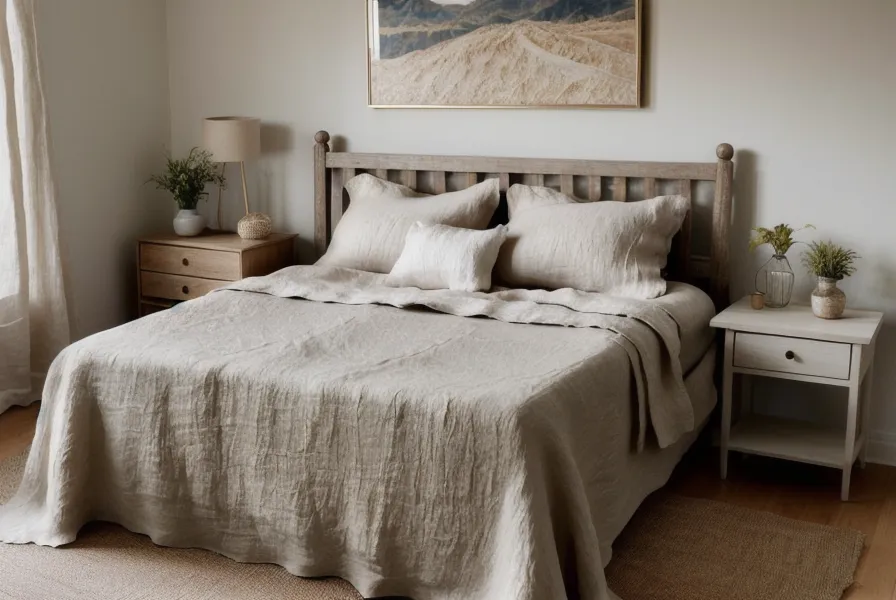
None of this works if the sheet on top fights the airflow instead of moving with it. Fabric matters here too: long-staple Egyptian cotton weaves into a thinner yarn and lets more air through than a standard weave, which is why I've stuck with a set of Schweitzer Linen Italian Sheets for a full year now. They fit a 14-inch mattress with room to spare, and the stitching hasn't given out after dozens of hot washes. How much heat a given fabric holds against your skin is its own subject I've covered in a separate fabric comparison, so I'll just say this: the weave matters more than the thread-count number on the packaging ever suggested to me.
Pillows are a smaller but real piece of it. Cotton cases hold onto facial oils and sweat until they're carrying a warm, damp patch by the middle of the night, so I switched to a Blissy Mulberry Silk Pillowcase at 22 momme and noticed the change inside a week. Silk doesn't soak the way cotton does, so the patch never forms. It slid around on the pillow the first few nights until I swapped to a tighter case, and for a single pillowcase that isn't cheap, it should behave from night one. The waterproof mattress protector underneath still makes itself known with a small crinkle whenever you roll over, a minor thing you stop noticing after the first few nights.
For the deeper mechanism on why silk changes that equation, I already laid it out in Why Blissy Mulberry Silk Pillowcases Help Hot Sleepers Stay Cool, so I won't repeat the case here.
Windows in a house this age turn into heat radiators by mid-afternoon, and no amount of bed-level airflow beats a room that's already baking before the sun even sets. Sealing the frames helped more than expected, cheap foam weatherstripping from the Home Depot on Broadway near Wilmot Road did that job before I spent real money, and the bigger jump came from cellular blackout shades through SelectBlinds, which dropped the room 4 to 5 degrees during peak afternoon sun. How much heat a room takes on through its own walls and glass before you even turn on a cooling gadget is a separate calculation, one I've run in full in a piece on blackout blinds and heat load, but the short version holds up: fix the window before you buy the next box.
A Season of Bedside Readings
The readings across a full season settle the argument better than marketing copy could. At bedtime, with the room sitting around 80 degrees, setting the BedJet to 68 on high fan gets the bed surface down to 70 in under three minutes. Deep in the night, with the room still holding near 78, the biorhythm mode drops to 64 on low fan and sleep stays uninterrupted through the stretch that used to wreck it. Toward morning, with the room at 77, the unit climbs back to 72, and waking up without the damp, sticky first few minutes of the day stopped being rare.
One morning this July the probe read 74 degrees at the usual wake-up check, the first reading under 76 since May, which says as much about the window seal and the blinds as it does about the BedJet. The electric bill mattered just as much as the thermometer: keeping the house thermostat at 78 and letting the bed handle the last few degrees kept the monthly total in the low three figures even during the worst stretch of the heatwave, a better payback window than replacing a twelve-year-old fridge compressor or retrofitting the whole HVAC system, a calculation I've run in full elsewhere. The number worth tracking turned out to be the mattress surface itself, something I get into separately in a mattress-topper roundup, not the reading on the wall thermostat. How much of your body actually touches a hot mattress changes how fast you overheat too, which is part of why airflow systems and side sleepers don't always get along, a mismatch I cover in a dedicated side-sleeper piece, but for a back sleeper, contact area was never the bottleneck here.
Active Airflow vs. Passive Materials, Side by Side
Laid out next to each other, the difference between an active system and passive bedding stops being an opinion.
| Feature | BedJet 3 | Silk/Cotton Sheets | Memory Foam Toppers |
|---|---|---|---|
| Cooling Method | Active Convection (Airflow) | Passive Wicking/Breathability | Conductive (Gel-Infused) |
| Temp Control | Precision Digital (Remote/App) | None (Ambient dependent) | None (Thermal saturation) |
| Maintenance | Monthly filter dust-off | Weekly laundering | Spot cleaning only |
| Noise Level | Low-to-Mid Hum | Silent | Silent |
The Right Order for Your Sleep Cooling Setup
If you're building this out from zero, all three pieces work together rather than as substitutes for each other. Schweitzer Linen sheets and a Blissy silk pillowcase handle the fabric side so nothing on top fights the airflow, while the BedJet 3 is the piece actually solving heat at skin contact instead of heat in the room, and it's the one I'd prioritize first if budget forces a choice. It lives at the foot of the bed in plain sight and hums a little at higher fan speeds, so it's not invisible or silent, and the upfront cost gets easier to swallow once you compare it to a year of running the AC at 65 all night. Skip anything marketed as antimicrobial as though that solves overheating, too: staying odor-free and staying cool are two different claims, a mix-up I've untangled in a separate sheet comparison.
The corrected version of the advice is simple. Stop shopping for a fabric that promises to feel cold, and start shopping for something that actually moves air across the one square foot of mattress where your body sits. Everything else, thermostat included, is secondary.