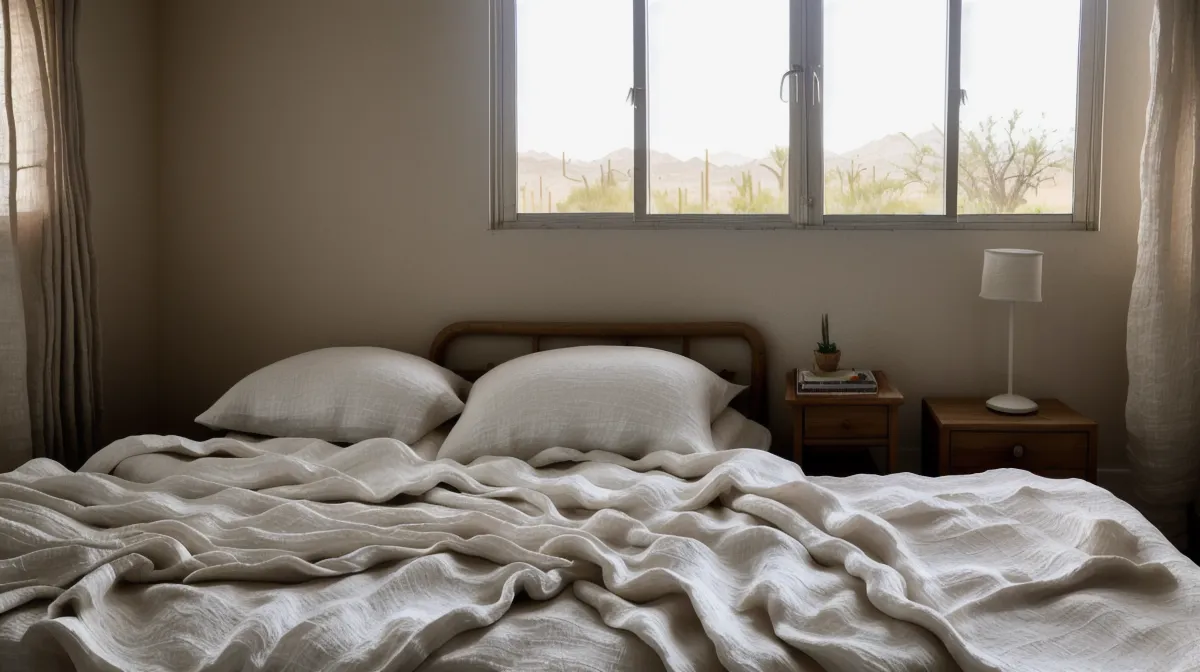
The ceiling fan pushes 82-degree air across the bed no matter how fast it runs.
Quick disclosure before the breakdown: some of the links below are affiliate links, and I earn a commission if you buy through them, at no extra cost to you. Everything mentioned got paid for with my own card and tested in this house, not sent free for a review. A punishing electric bill one July is what pushed me from treating the whole house as the cooling problem to treating the bed as its own thermal zone, and that shift is really what this piece is about, not sleep-tech in the lifestyle-magazine sense, but desert-living solved the way you'd solve any other energy-efficiency problem in an old house.
What Passive Bedding Actually Gets Wrong
Passive bedding was the first thing I threw money at, and it's worth explaining why it has a ceiling. I switched to a set of 1000-thread-count Egyptian cotton sheets marketed as breathable, the kind of claim that shows up on every package in this category, and the room's starting temperature didn't move an inch. The Schweitzer Linen Italian Sheets I tested afterward are genuinely well made, long-staple Egyptian cotton, tight stitching, the kind of build quality you'd expect from pricing out a high-end appliance instead of a bargain one. None of that changes the physics: a sheet can only move moisture off the skin, not perform heat transfer against a room that's already pushing 80 degrees. Fabric can slow how fast your body loses heat to begin with, which is useful in January and working against you in July.
Thread count and breathability get marketed as interchangeable, and a denser weave can trap heat against the skin even while technically wicking sweat away from it. Weave structure and fiber content get blurred together the same way, as if a tight percale and a loose linen weave in the same fiber would perform identically, which they don't. Some sheets also feel cold against the skin for the first few minutes and then creep back up to room temperature, a surface effect rather than sustained heat removal, and it fooled me longer than I'd like to admit. The spot where skin actually contacts the mattress holds heat longer than the open air above it no matter what fabric is covering it, and that's the gap active airflow is built to close.
Active Cooling, Defined
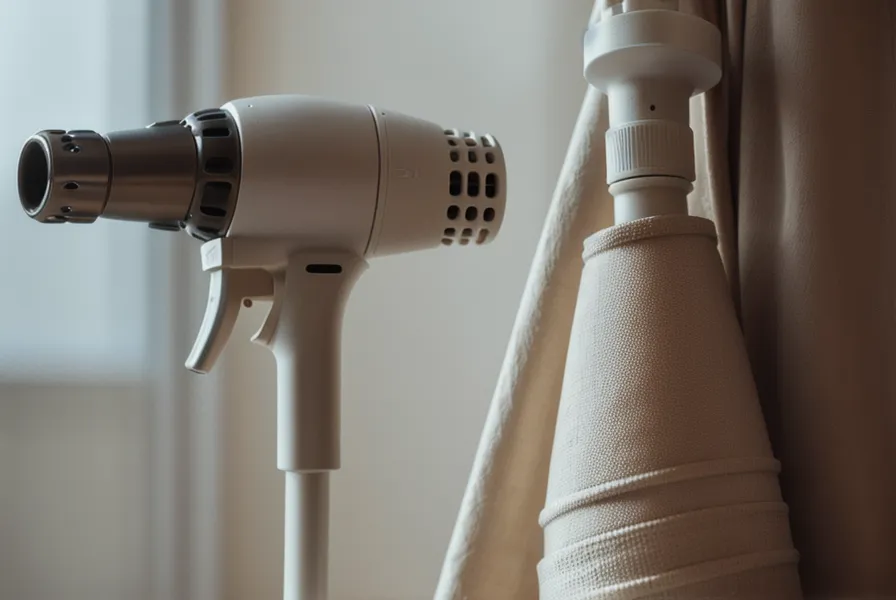
Active cooling means something specific, and it isn't just a better fan. Passive cooling manages moisture and reflects or absorbs ambient heat, while active cooling adds energy to move air or fluid across the sleep surface on purpose. The BedJet 3 [Editor's Pick] is the unit I run most nights, and it works through forced airflow under the top sheet instead of a cooled gel or water layer, which means it's chasing evaporative cooling off the skin rather than conductive cooling through a cold surface underneath you.
Sleep-surface temperature is the number that actually matters here, not room temperature, and my probe thermometer shows a real, measurable gap between the ambient air and the bed surface within a few minutes of the unit switching on. Core body temperature has to drop a couple of degrees to stay in deep sleep, and that's a slower biological process that directed airflow under the sheet nudges along in a way sitting under a ceiling fan never managed for me. Pull the sheet back the next morning and, for the first stretch in a long while, the mattress underneath isn't damp. Whole-room cooling and bed-level cooling are solving different problems: conditioning 1,400 square feet to a temperature the AC can barely sustain through a desert July is an expensive, losing fight, where treating the eighteen inches around your body as its own climate zone is a much smaller problem to solve well. Morris, a friend who's dealt with Phoenix summers longer than I've dealt with Tucson ones, had already burned through an earlier version of this kind of unit before I bought mine, and his advice was to stop judging the hose by how it looks and start judging it by the electric bill it replaces. The full rundown on how I actually run it night to night is in Tucson Summer Survival: My Honest Answers on BedJet and Cooling Tech After a Season in the Desert.
Is Night Sweat a Different Problem?
Night sweats triggered by a hormonal surge aren't the same mechanism as a room that's simply too warm, and it's worth keeping those separate even though the fix overlaps, since a hormonal heat spike is closer to a medical thermoregulation question than a bedroom-climate one, and I'm not the person to weigh in on the medical side of that. What I can say from the mechanical side is that moving air across the skin fast helps in both situations, because evaporative cooling doesn't care what caused the heat, only that it's there to remove. Silver-infused or antimicrobial sheet fibers get marketed heavily to this same audience, and that solves a different problem entirely: odor and bacterial growth, not moisture management or heat removal. The airflow argument is laid out in more depth in Cooling Bed Systems for Night Sweats After a Desert Summer, and it tracks with what my own thermometer logs show.
Fixing Humidity, Not Just Heat
Monsoon season changes the equation because relative humidity does something temperature alone doesn't: it slows evaporation off the skin, so the same mid-80s room feels worse once the air turns sticky in late summer. Swapping to the Blissy Mulberry Silk Pillowcase [Best for Hair and Skin] made a bigger difference here than I expected, mostly around the face and neck, where humidity makes cotton feel clingy even when the room isn't particularly hot.
A memory foam topper I tested earlier in the season told a different story. It arrived with that sharp, chemical smell new foam carries, and with the windows shut against the afternoon sun, that smell sat in the bedroom for days before it faded; a densified foam layer like that traps heat at the surface well before moisture even enters the picture. Waterproof mattress protectors run into a similar trade-off, since the barrier that keeps liquid from reaching the foam underneath is frequently the same layer that keeps air from moving through it, so a fully waterproof protector and a genuinely breathable one tend to pull in opposite directions. The silk pillowcase doesn't solve any of that by itself, but Silk vs Satin Pillowcase for Hot Sleepers in a Dry Climate goes into the weave comparison in more depth than I will here.
Stopping the Heat Before It Reaches the Bed
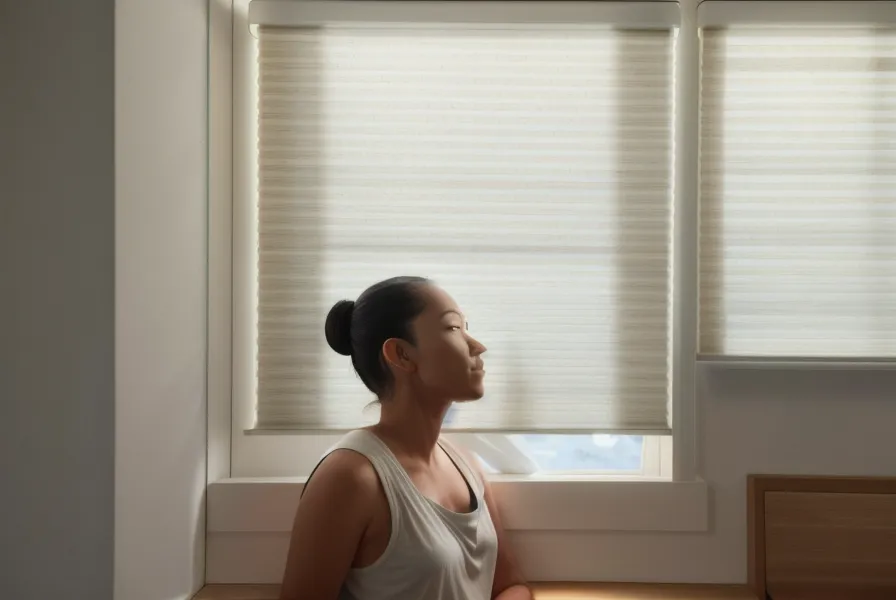
Stopping heat from entering the room in the first place is cheaper than fighting it once it's inside, the same logic behind attic insulation or a better seal on an old front door. A window with worn weatherstripping pumps heat into a room all afternoon regardless of how good the insulation is elsewhere, and no bed-level cooling system can fully outrun that load if the room envelope itself is leaking. Replacing my old roller shades with SelectBlinds [Best Bedroom Blackout] cellular shades cut the room-temperature rise during peak afternoon sun by more than I expected from something that's just fabric and a honeycomb cross-section.
Wendell, someone I've traded notes with for a couple of years now, builds most of his own solutions before he'll buy one, and his first instinct here was to rig something out of foam board and blackout cloth. He came around to buying actual cellular shades once he ran his own numbers against the cost of materials and his own time. The full breakdown on that shade swap is in Energy Efficient Blinds from SelectBlinds for Cooling a Hot Bedroom.
The Energy-Efficiency Payback Window
Running the actual math is what separates this from a lifestyle purchase. A payback window is simple in concept: take what the gadget costs, take what it saves in reduced whole-house AC runtime, and see how many months it takes to break even, the same way you'd evaluate a heat pump or a tankless water heater before signing off on one. Bumping the house thermostat a few degrees warmer while running the BedJet 3 at the bed level cut my whole-house AC runtime enough to show up on the bill, which is the only number that actually justifies the unit's cost on paper instead of on comfort alone.
My rule of thumb now is simple. If a passive product can't show a measurable temperature or humidity change on a thermometer within the first week, it goes back. If an active product can, but costs more than a year of running the AC harder to compensate, it's not worth it either. That's the one test every cooling-bedding purchase in this house has to pass now, soft fabric claims and hard engineering specs alike, and the BedJet 3 is the only piece of gear here that's passed it two summers running, a longer track record than most things that show up with a slick unboxing video ever manage.