Four hundred eighty-seven dollars. That was the July electric bill the summer I dropped the thermostat to 68 trying to force a memory foam mattress in Tucson to stop sleeping hot. With the central air set to 76, the bedroom already drifts into the high 70s and low 80s by nine at night, and the foam soaks up every degree my body gives off and holds it there. Cranking the whole house colder felt like the obvious cooling move. It chilled the air and did almost nothing for the mattress — which is why the fixes that actually worked turned out to be cheap mattress hacks, not a colder thermostat.
That bill taught me the most useful thing I know about cooling a memory foam bed: the air in the room and the surface you sleep on are two separate problems, and money poured into one barely touches the other. It's the same math as pricing a new heat pump to see whether it ever pays for itself, or deciding it's cheaper to replace a tired fridge than keep feeding an old compressor. You cool the whole room, or you cool the surface with a handful of mattress hacks that cost almost nothing. Two levers, and they pull in very different directions.
Cooling the Air Versus Cooling the Foam
Dropping the thermostat is brute force. It cools the air fast, and when the room itself is the real problem, that's the right tool to reach for. A memory foam bed, though, is dense and closed off. The same softness that makes it feel like a hug is what makes it hold heat, so it keeps banking your body warmth even while the thermostat reads a comfortable number. You end up paying whole-house prices to chase a problem that lives in the couple of inches under your back. The $487 was the proof: colder air, same warm mattress.
Morris, a college friend who landed in Phoenix a decade back, likes to text a link to some new cooling gadget past midnight with a one-word review attached: "meh," most nights. A lot of what he sends leans on the same promise: a fabric or a Phase Change Material that supposedly pulls heat off you on contact. That promise runs out fast in a bedroom that never really cools down. There's a real line between leaning on the room to do the cooling and building something that actively moves heat off the bed, and most of the gadgets Morris flags sit on the wrong side of it for a room like mine.
Working the Mattress Surface Instead
Start with the layers you can actually control. Piling a thick foam topper on top is the intuitive move, and it usually backfires — you've stacked one more insulating slab over the reservoir, so your body heat now has an extra dense layer to cross before it can leave. A topper only earns its keep if it's thin and open enough to breathe, not more of the same foam that started the trouble. The thermal conductivity of the whole stack matters far more than any "cool-to-touch" label on the box, and that first-touch chill fades the moment the fabric warms to your skin.
Underneath the mattress is where the cheapest win hides. A solid platform or a boxed-in base traps heat against the bottom of the foam like a board laid over a floor vent; a slatted foundation with real gaps, and a few inches of open air under the frame, lets the bed shed heat downward instead of banking it back into you. No watts, no monthly charge, just a path for warm air to leave.
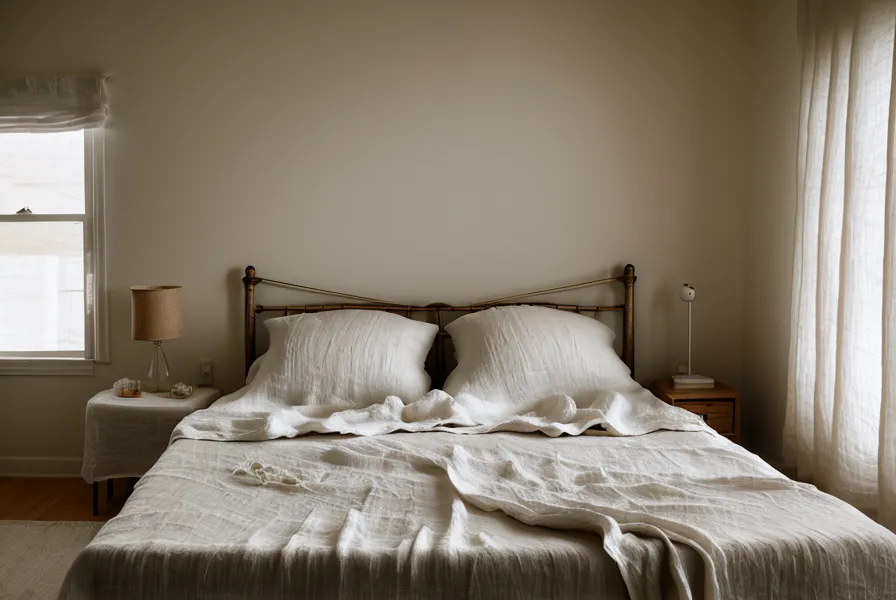
Sheets carry more of the load than people give them credit for. A tight, heavy weave presses heat right back against the surface, while breathable moisture wicking sheets let air and sweat pass through instead of sealing them in. Pair that with the open foundation and a floor fan aimed to push air under the frame, and you've built a slow draft through the bed rather than a sealed pocket. Keep the surface dry while you're at it — a waterproof protector earns its place, even if you catch its faint crinkle every time you shift your weight, and a damp surface always sleeps warmer than a dry one.
The clearest proof that surface beats air came on a night I woke in the small hours with the pillow's underside still cool under my palm while the mattress beneath my back had gone warm as a plate left out on the counter. Same room, same air, two very different temperatures. The bed was the reservoir, not the air around it.
Does Sleep Hygiene Change the Calculation?
Sleep hygiene — a dark room, a steady bedtime, screens put away — is worth doing, and it helps you fall asleep. It does not change thermodynamics. A calm wind-down won't pull heat out of a foam block that's busy banking it; that's a job for airflow and thinner layers. Treat hygiene as what gets you to sleep and the surface work as what keeps you there when the room is still warm at midnight.
Choose the Room or Choose the Surface
Here's the split I'd hand anyone asking which way to spend. When the room itself is the bottleneck — a bedroom that bakes all afternoon and starts the night already hot — put the money into the room, and look hard at an active system that moves heat off the bed instead of hoping the foam behaves. Wendell, who I trade notes with on a home-improvement forum, sleeps in Las Vegas where the bedroom starts hotter than mine ever gets; for him the whole-room route earns its keep, and it's exactly the case where the summer I broke down and bought a BedJet changed the math. When the room is only warm and the mattress is the reservoir — the everyday case in a Tucson house with the air set to 76 — spend on the surface first. It costs next to nothing, it lands right where the heat actually sits, and it's what finally made a hot-sleeping foam mattress livable through a desert summer without the bill creeping back toward $487.