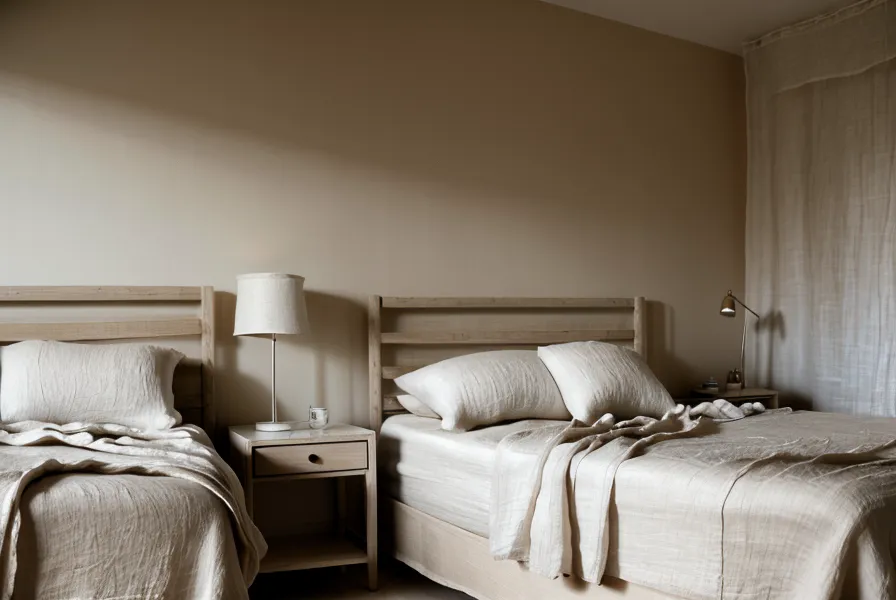
A gel-infused mattress topper and a phase change material panel can both get sold under the same cooling bedding label, and they do almost opposite things. One is a heat sink that fills up and quits working. The other is built to reset itself at a fixed temperature, over and over, all night. I didn't understand that difference until a topper I'd bought a few weeks earlier turned into something close to a heating pad against my lower back, radiating my own body heat straight back at me instead of pulling it away.
My house is a single-story 1990s build on a quiet subdivision block, running a 10 SEER unit — the bare federal efficiency minimum the year it went in. Two years into logging this bedroom with a probe thermometer, I've learned the compressor outside is already working at its ceiling most of July and August, so the last thing I need is bedding that quietly hands heat back partway through the night. That's the mistake most cooling marketing leans on: it sells the first five minutes, not the eighth hour.
A Cold Sheet and a Stable One Are Not the Same Product

Most of what gets marketed as cooling bedding plays the same trick: it feels cold for a minute, and that minute is doing all the selling. Gel-infused foam is a passive heat sink — it absorbs warmth until its capacity runs out, and in a room that doesn't drop much below 78 degrees overnight, that capacity is gone in well under an hour. After that you're lying on a warm sponge that still has the word cooling printed on the tag. Water-cooled, pump-driven systems are a different category of sleep tech entirely — active cooling instead of passive absorption — but that's a separate piece of hardware and a separate conversation.
There's also a backfire version of the cold-sensation trick, where a surface distinctly colder than your skin triggers a reflex rush of blood to warm the spot back up, so the chill doesn't last — a separate rabbit hole, and not the one I'm solving here. What actually changed things was a category of material I'd assumed was marketing nonsense: phase change material, PCM for short, engineered originally to hold astronauts at a stable body temperature in space. If it could do that in a vacuum, a Tucson bedroom seemed like a reasonable ask.
How Phase Change Material Resets Itself at 82 Degrees

The mechanism is simple once you see it laid out. PCM bedding uses paraffin wax sealed inside microscopic capsules, millions of them, bonded into the fabric itself. Push the surface temperature up with body heat, and the wax melts, pulling that heat in instead of reflecting it back. Let the surface cool, and the wax solidifies again, releasing what it stored. None of it ever gets wet, because the wax stays sealed in its capsule the entire time.
That melt point sits at 28 degrees Celsius, 82.4 Fahrenheit, for most consumer PCM bedding — the spot where the wax flips from solid to liquid and back. This is also where people misread the technology the same way they misread gel: PCM isn't a permanent cold source, it's a battery that needs recharging. Keep the room above 82 degrees around the clock, and the wax sits melted and 'charged,' with nowhere left to put more heat — the bedding still feels neutral to the hand, but it's stopped doing anything useful. Treat it like hardware with a duty cycle, not a topper you buy once and forget.
The Room Decides Whether Any of This Works
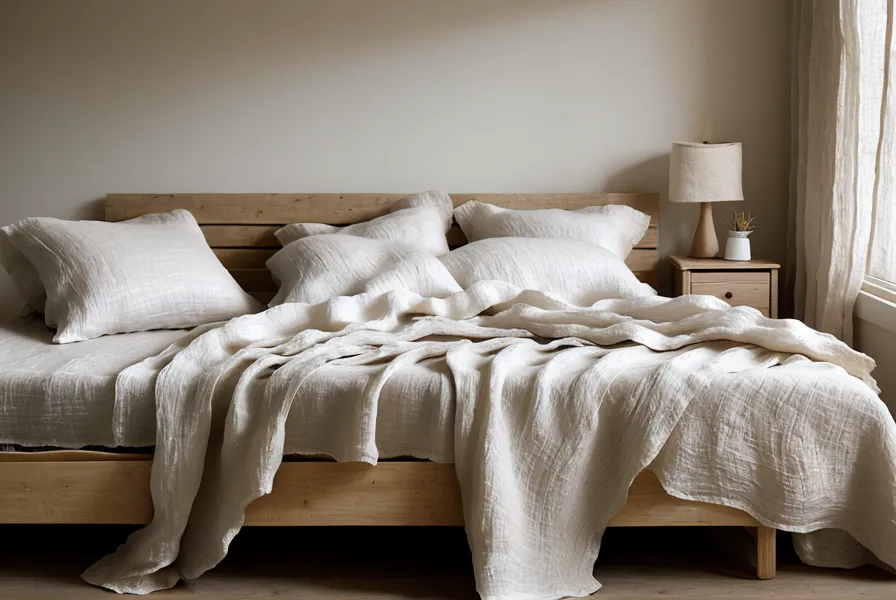
My test bedroom doubles as overflow office space, with a probe thermometer zip-tied to the bed frame at mattress height so the reading comes from where my body actually sits, not from a vent across the room. A separate piece covers a full year of chasing this problem at the whole-room level — insulation, blackout coverage, window unit versus central system — and none of that is optional if you want a PCM layer to actually discharge during the day. Humidity matters here too, apart from temperature: a room that's 80 degrees and dry behaves nothing like a room that's 80 degrees and damp, and PCM bedding answers to both.
Before any of this, my fix was ice packs wrapped in dish towels, stacked at the foot of the bed. They bought maybe twenty minutes before the towels went soft with condensation and the fitted sheet underneath was wetter than I was. My neighbor Peg saw the PCM pillowcase drying on the line and asked, flatly, if I'd started sleeping on a juice pouch — she's never trusted anything that isn't cotton or wool, and a pouch of encapsulated wax wasn't going to change that. The clearest sign something had actually shifted came on an ordinary morning, sitting up out of habit a few minutes before six, when my neck wasn't doing the usual damp, sticky thing it did on every gel-topper morning before it.
Ask About the Reset Point, Not the First Five Minutes

So here's the rule I wish had been printed on the box: ask what temperature a product stabilizes at and how long it holds there, not what it feels like the second your hand touches it. Your core body temperature only needs to drop two or three degrees to let you fall into deep sleep, and a surface that holds steady at a reasonable number does more for that than one that starts dramatically cold and then rebounds. Layering matters more than people expect, too — anything thick enough to trap a pocket of still air between your skin and the PCM capsules defeats the whole mechanism, which really comes down to how much of your skin stays in direct contact with the active layer.
Fabric choice changes the outcome on its own, separate from any of this. A tight, heavy weave holds heat no matter what fiber it's made from, and a loose, open weave breathes no matter the thread count, which is why I stopped assuming a higher thread count sheet was doing me any favors over a PCM layer underneath it. Gel foam's problem was never really about the gel, either — it's a foam-density issue, the same reason an older memory foam mattress sleeps hotter than a newer one.
A reader named Joanna, out in Phoenix, emailed after finding the site mid-search and described running through three different products before any of it clicked for her, which tracks, because most of the obvious options solve a problem next to the real one instead of the real one. A waterproof mattress protector solves spills, not heat, and usually trades away some breathability to do it. Silver-infused or antimicrobial sheets solve odor and bacteria, not temperature. An evaporative cooler down the hall solves whole-house humidity in a way a tower fan never will, but it's not a bed-level fix. None of those are wrong products. They're just answering a different question than the one PCM answers.
None of this is about a medical night-sweat problem, either — that has its own causes and its own fixes, and PCM bedding was never marketed to treat it. It's about ordinary thermoregulation in a house that heat-soaks hard by late afternoon. The honest payback math looked like keeping the thermostat at 78 instead of 74 without waking up soaked, which in a house this age works out to roughly three to five percent off the cooling bill for every degree I don't have to run colder. That's a smaller number than I wanted, but a real one, and a lot cheaper than pricing out another HVAC unit at $8,000 just to stand still. Keep the room humidity under 45 percent, give the material a few daylight hours to discharge, and judge it by where the thermometer sits at the end of the night, not by what your palm reports in the first five seconds.
The sensation worth wanting from bedding is forgettable, not dramatic — a surface that stays close to neutral long enough that you stop noticing it at all. If a product can't tell you what temperature it's aiming to hold, or for how long, that's the question for the box, not how cold it feels off the shelf.